Tracking your competitors in AI answers: which tool, and what to measure
Updated · published · 13 min read
To track your competitors in AI answers, you need an AI visibility tracking tool that asks your customers' questions to several AI engines every day, and measures four things for each brand: its presence, its share of voice, its position in the answer and the sources that cite it. Otterly.AI, Peec AI, SE Visible, HubSpot AEO and i am rank track competitors on your own questions; Ahrefs Brand Radar and Semrush also show the visibility of any brand in a database of prompts they have already run. Pick between them on the engines included and on what the tool tells you to do when a competitor gets ahead of you.
This guide covers the metrics to track, a real example from our own market, what changes from one AI engine to the next, the method in 5 steps, what to do when a competitor gets ahead of you, and the tools that do it, based on their official pages checked on November 22, 2026.
Which tool to track your competitors in AI answers?
| Tool | Competitors | Share of voice | Cited sources | Engines | Entry price |
|---|---|---|---|---|---|
| i am rank | Unlimited, spotted from the first scan | Yes, engine by engine | Yes, and the sites that cite them and not you | 10 | €49 excl. VAT, 25 prompts |
| Otterly.AI | Unlimited | Yes | Yes, ranking of cited domains | 4 out of 7 | €29, about 16 prompts |
| Peec AI | Unlimited, with suggestions | Yes, daily | Yes, and the ones that name them and not you | 3 of your choice | $95, 50 prompts |
| SE Visible | Unlimited | Yes, with average position | Yes, citation gaps | 5 | €80, 75 prompts |
| HubSpot AEO | Yes | Yes | Yes, by source type | 3 | €49, 25 prompts |
| Semrush AI Visibility Toolkit | Identified automatically | Yes | Yes, and the prompts where they're cited and you aren't | 4 | $99 (€94.94 on annual billing), 25 prompts |
| Ahrefs Brand Radar | Any brand in the index | Yes | Yes, by page and by domain | 6 in the index | Prompt index from €179 |
Official pages checked on November 22, 2026, monthly price of the entry plan on monthly billing, unless stated otherwise. Sources: i am rank, Otterly.AI, Peec AI, SE Visible, HubSpot AEO, Semrush, Ahrefs Brand Radar.
Two families stand out. Prompt tracking tools (i am rank, Otterly.AI, Peec AI, SE Visible, HubSpot AEO) ask your questions every day and compare your brand with your competitors on those questions. Prompt databases (Ahrefs Brand Radar, and Semrush on top of its tracking) have already asked AI engines millions of questions: you see right away where a competitor shows up, even on questions you hadn't thought of tracking. Profound also tracks your competitors' presence, citations and position, on its Enterprise plan, on quote.
The 6 metrics to track for each competitor
| Metric | What it tells you | How it's calculated |
|---|---|---|
| Presence | In what share of answers the AI names the brand | Answers that name it ÷ answers collected |
| Share of voice | The brand's weight against the others | Its mentions ÷ mentions of all brands |
| Position | Whether it's cited first or at the end of the list | Its average rank in the answers where it appears |
| Sources cited | The sites the AI relies on to recommend it | Domains and pages cited in those answers |
| Gaps | The questions where it's named and you aren't | Questions where it appears, minus the ones where you appear |
| Tone | How the AI describes it | Positive, neutral and negative mentions |
Calculate each metric engine by engine before averaging. A competitor can dominate ChatGPT and be missing from Gemini: according to the Semrush AI Visibility Index 2026, less than half of citations overlap from one platform to another. The detailed share of voice formula, with a worked example, is in our article on AI share of voice (in French).
A real example: our competitors in AI answers
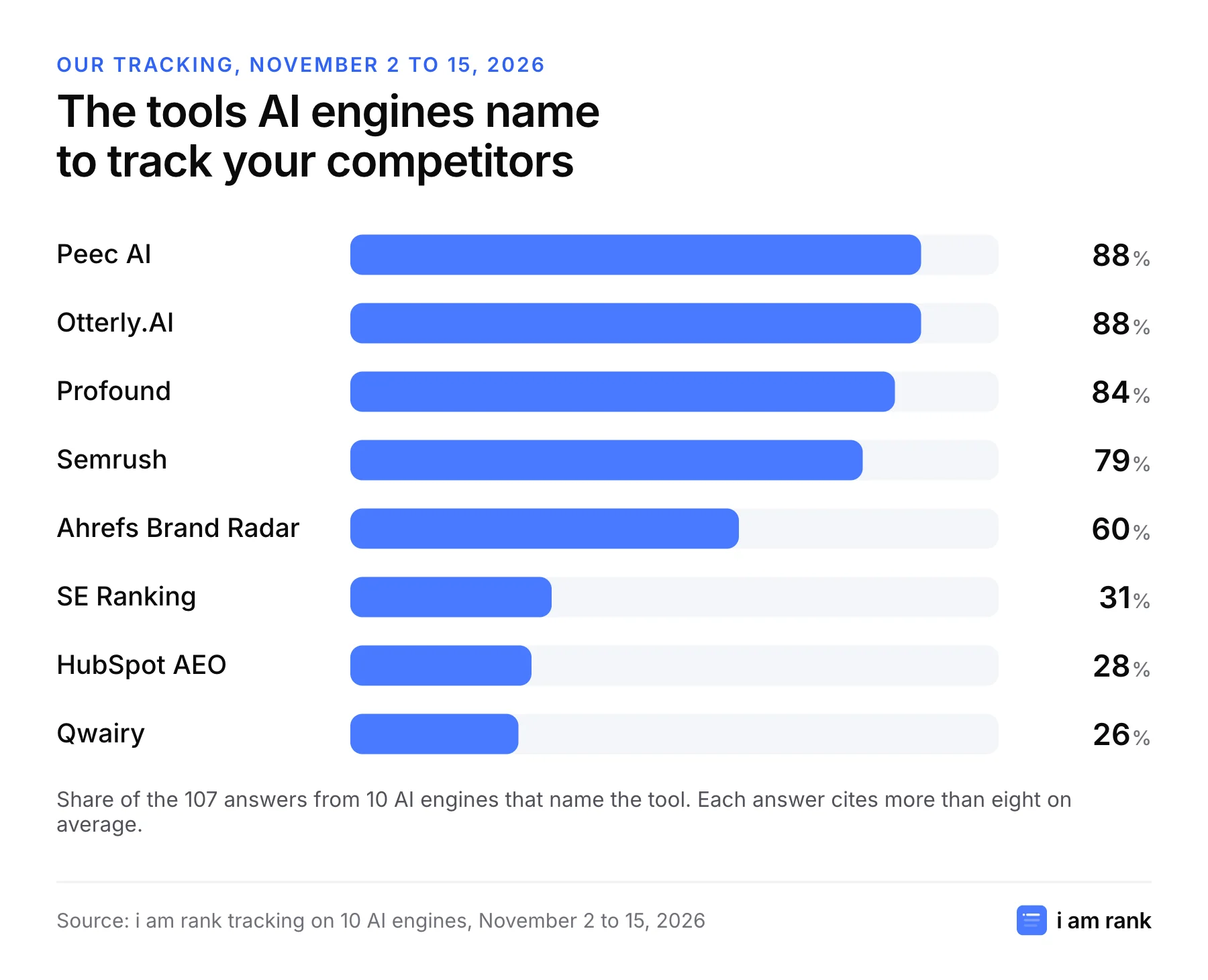
Every day, on 10 AI engines (ChatGPT, Gemini, Claude, Perplexity, Copilot, Mistral, DeepSeek, Grok, Google AI Overviews and AI Mode), we track the question "Which AI visibility tracking tool to track your competitors in AI answers?", asked in French. Here is what the 107 answers collected from November 2 to 15, 2026 show.
| Tool | Presence | Share of voice |
|---|---|---|
| Peec AI | 88% | 10.4% |
| Otterly.AI | 88% | 10.4% |
| Profound | 84% | 10.0% |
| Semrush | 79% | 9.4% |
| Ahrefs Brand Radar | 60% | 7.1% |
| SE Ranking (SE Visible) | 31% | 3.7% |
| HubSpot AEO | 28% | 3.3% |
| Qwairy | 26% | 3.1% |
Three lessons to carry over to your market:
- Presence and share of voice don't say the same thing. Peec AI is named in 88% of answers, but only weighs 10% of mentions, because each answer cites more than eight tools on average. In a crowded market, the place in the list matters as much as being there.
- Vendors' own websites are the top sources. Out of the 89 answers that list their sources, seranking.com is cited in 25% of them, semrush.com and otterly.ai in 22%, peec.ai and ahrefs.com in 18%, tryprofound.com in 17%. Your competitors win first with their own pages.
- Comparison articles and forums come next. koino.fr and reddit.com appear in 16% of answers with sources, geotoolbox.ai in 15%. Those are the pages to aim for to sit next to your competitors.
What changes from one AI engine to the next
A competitor never weighs the same on every AI engine: track it engine by engine, or an average will hide the engine where it leaves you behind. On our question, Semrush is named in 94% of Gemini's answers and in 31% of Copilot's; Ahrefs in 86% of AI Mode's answers and in 7% of AI Overviews', two Google products.
| AI engine | Answers | Peec AI | Otterly.AI | Semrush | Ahrefs | Qwairy | Answers with sources |
|---|---|---|---|---|---|---|---|
| ChatGPT | 16 | 100% | 100% | 75% | 81% | 19% | 14 |
| Gemini | 16 | 88% | 94% | 94% | 75% | 25% | 14 |
| Perplexity | 14 | 86% | 86% | 93% | 43% | 7% | 14 |
| Copilot | 13 | 92% | 69% | 31% | 15% | 77% | 13 |
| AI Overviews | 14 | 79% | 79% | 86% | 7% | 36% | 14 |
| AI Mode | 14 | 64% | 86% | 79% | 86% | 7% | 14 |
| DeepSeek | 14 | 100% | 100% | 100% | 100% | 0% | 0 |
Share of each AI engine's answers that name the tool, on the same question, from November 2 to 15, 2026. The 2 ChatGPT and 2 Gemini answers without sources are memory checks, with no web search. Claude, Mistral and Grok, checked less often, gave 2 answers each over the period: too few for a percentage.
What this table changes in your tracking:
- A competitor can lead on one engine and weigh little on another. Semrush is named in 93% of Perplexity's answers and 94% of Gemini's, but in 31% of Copilot's. If your customers use Copilot, it gets in your way less than you think.
- Google's two AI engines don't answer the same way. Ahrefs comes up in 86% of AI Mode's answers and in just 1 of the 14 AI Overviews answers. Track them as two separate engines.
- Some competitors live mostly on one engine. Qwairy is named in 10 of Copilot's 13 answers, and in 1 out of 14 on Perplexity as on AI Mode. Averaged over all 10 engines, it tops out at 26%, and you'd miss the engine where it matters.
- Without sources, you still have the text. DeepSeek gives no source in any of its 14 answers: it answers with what the model has learned. You can't trace it back to a page; read how it describes each competitor.
The method in 5 steps
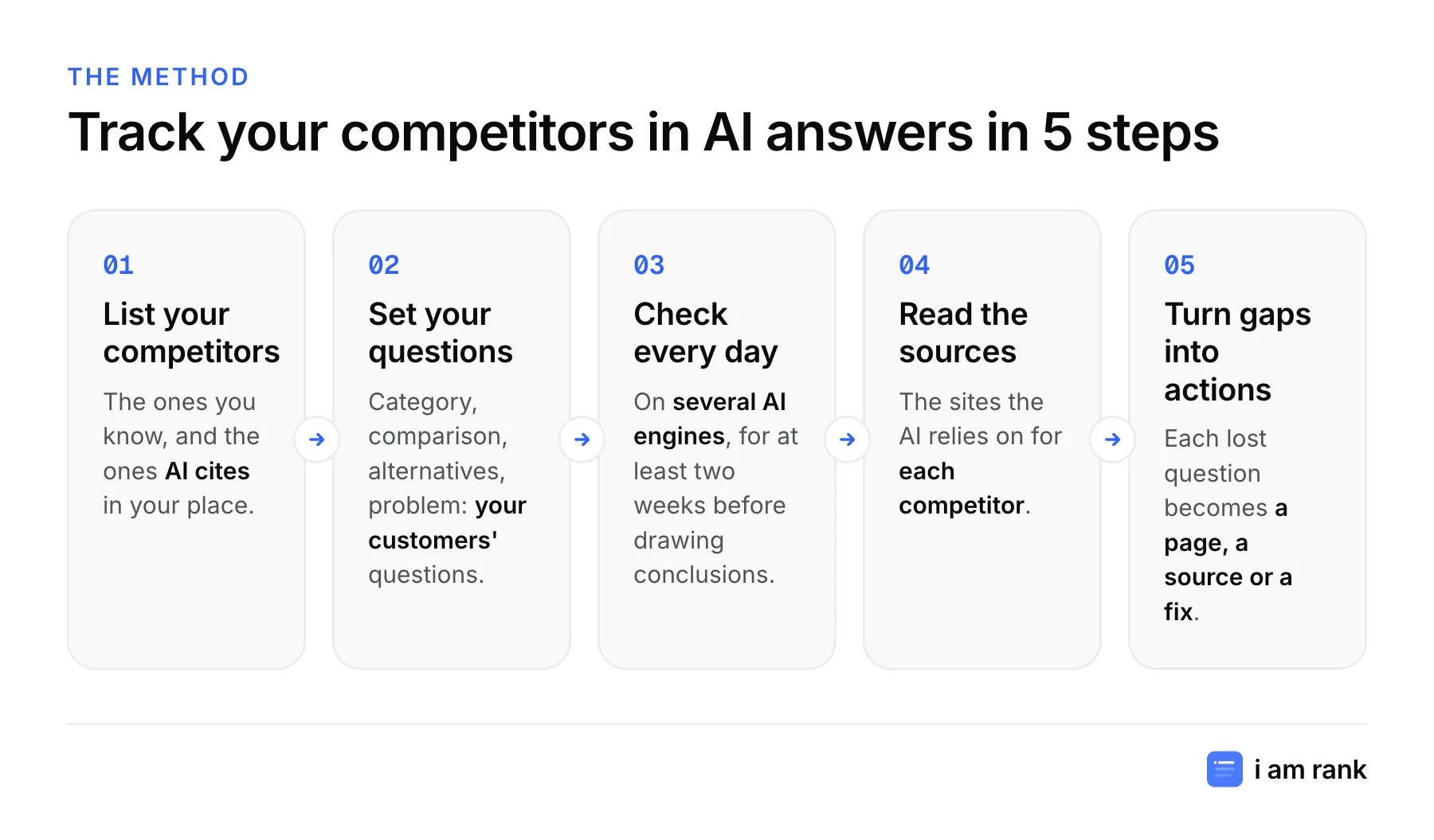
1. List your competitors, including the ones you don't know
Start with your usual competitors, then look at who AI engines actually name on your questions. Often, a brand you hadn't thought of takes a good share of the answers: in our example, each answer cites more than eight tools, and lesser-known names like Botrank.ai or Knowatoa come up in 16% of answers. A good tool spots these brands on its own: i am rank detects them from your first scan, and Peec AI and Semrush also suggest or identify competitors.
2. Set the questions your customers ask
Not your brand name: the questions where the customer makes a choice. Four families are enough to start:
- category: "what's the best invoicing software for a small business?";
- comparison: "Competitor A or Competitor B?";
- alternatives: "what are the alternatives to Competitor A?";
- problem: "how do I chase a client who won't pay?".
Then keep the same set over time. If you change the questions, share of voice shifts mechanically and you're no longer comparing anything. To know how many to track, our article on how many prompts to track (in French) gives the rule.
3. Check every day, on several AI engines
A model never answers the same way twice: a single answer can leave out a competitor it cites every other day. Check every day, at least on ChatGPT, Gemini and Google's AI Overviews, and add Claude, Perplexity, Copilot or Mistral if your customers use them. Wait for two weeks of data before drawing a conclusion. By hand, the method works on a few questions; our guide to testing your visibility on ChatGPT by hand (in French) shows its limits.
4. Read each competitor's sources
This is the step that turns a table of scores into an action plan. For each competitor, look at the pages the AI cites when it recommends them: their own product page, a comparison article, a Reddit thread, a review site. The sources where your competitor appears and you don't are your most direct targets. Our article on the sources that shape your reputation in AI (in French) explains which ones weigh most.
5. Turn each gap into an action
For each question where a competitor is named and you aren't, three possible answers:
- a page to write or rework on your site, which answers the question in a few lines right at the start (see how to write content AI cites (in French));
- a source to win over: the comparison article, directory or media outlet the AI cites;
- a piece of information to fix when the AI describes your brand poorly next to theirs.
Then track the effect week after week, on the same questions.
What to do when a competitor gets ahead of you
First look at where it gets ahead of you: on every engine, on just one, recently, or with a specific argument. Each case calls for a different action, and the score table isn't enough to choose: you have to open the answers.
| What you see | What it means | What you do |
|---|---|---|
| It's ahead of you on every engine | It has strong sources everywhere: its own pages and the market's comparison articles | Go first for the sources several engines cite for it, then for the page on your site that answers the question |
| It dominates a single engine | That engine reads its own sources: Bing's index for Copilot (in French), Google's results for AI Overviews (in French) | Read that engine's sources only, and check that your pages are indexed there (Bing Webmaster Tools for Copilot) |
| It recently overtook you | It published a page, won a spot in a comparison article, or the model changed | Compare the sources cited before and after, and open the new ones |
| The AI recommends it with a specific argument | That's the argument the answer keeps: a price, a feature, a type of customer | Answer that argument on your page, with facts the AI can check |
| The AI gives no source at all | The answer comes from what the model has learned | It will only move with the model's next versions: build up recent, accurate mentions in reliable sources |
If the AI describes you poorly next to your competitor (an old price, a missing feature), treat it as an error to fix: our guide on AI hallucinations about your brand (in French) explains how to trace it back to the source.
What i am rank does to track your competitors
i am rank asks your questions to the 10 major AI engines, all included in every plan, and tracks your competitors with no limit on their number. For each question, you see the AI's full answer with your brand highlighted, your competitors and the sources cited. AI visibility calculates your share of voice against them, engine by engine; citation analysis shows who is cited on each source, you or a competitor; alerts tell you when a competitor overtakes you on a prompt. From the Pro plan, recommendations list the questions and pages where your competitors are cited and you aren't, ranked by impact.
The Solo plan costs €49 per month excl. VAT for 25 prompts, the Pro plan €149 excl. VAT for 80 prompts and 5 brands. The details are on the pricing page, and the free scan shows you in two minutes the competitors AI cites in your place.
If you're still choosing a tool, our comparison of AI visibility tracking tools covers the 11 most cited tools, and the guide which tool for which need sorts them by problem. For a marketing team or a small business, our comparison of the best AI visibility tracking tool for marketing teams compares what tracking one brand costs across 10 tools.
Frequently asked questions
Which AI visibility tracking tool to track your competitors in AI answers?
A tool that tracks unlimited competitors on your own questions, calculates share of voice engine by engine and shows the sources that cite each competitor. i am rank, Otterly.AI, Peec AI, SE Visible and HubSpot AEO do this, from €29 to $95 per month to start. Ahrefs Brand Radar and Semrush add a database of prompts already run, useful to spot a competitor on questions you weren't tracking.
How many competitors should I track?
All the ones AI engines name on your questions, not just your usual competitors. In a crowded market, that quickly adds up to about ten brands. Most tools in this guide track an unlimited number of competitors, so the limit is rather the number of questions.
How do I find out which sources cite a competitor?
Open the answers where it's named and look at the links the AI gives. A tracking tool collects this for you: it ranks the domains and pages cited, and shows the ones where your competitor appears and you don't. In our own market, the vendors' own websites are the most cited sources.
How do I calculate my share of voice against my competitors?
Divide the number of mentions of your brand by the total number of mentions of all brands, on the same set of questions, the same engine and the same period. If the brands in your market are cited 200 times and yours 40 times, your share of voice is 20%.
Can I track a competitor without knowing their prompts?
Yes, with a database of prompts already run. Ahrefs Brand Radar queries more than 581 million prompts on six engines (AI Overviews, AI Mode, ChatGPT, Perplexity, Gemini, Copilot) and shows the visibility of any brand. Semrush also offers prompt research and a competitor report. To track the effect of your actions, you then need your own questions, checked every day.
Should I track my competitors on every AI engine?
On every engine your customers use, and on each one separately. On our own question, Ahrefs is named in 86% of AI Mode's answers and in 7% of AI Overviews', and Qwairy in 77% of Copilot's answers and in 7% of Perplexity's. An average across all engines hides these gaps.
How often should I check?
Every day on the major engines, to smooth out the randomness of answers, and for at least two weeks before concluding that a competitor is gaining ground. A change over a single day means nothing.
Can I track my competitors for free?
For a starting snapshot, yes: the i am rank free scan shows the competitors AI cites in your place, and a manual test on a few questions gives a first idea. For a trend over time, across several AI engines, you need a tracking tool.
Share this article
Useful resources
- AI visibility scanYour score out of 100 in 2 minutes, on ChatGPT, Claude, Gemini, Perplexity and AI Overviews.
- llms.txt generatorEnter your site's address, and AI writes the file.
- AI crawler simulatorSee your page the way GPTBot sees it.
- Prompt calculatorHow many questions to track for your brand, and which ones.
- GEO glossaryThe words of AI visibility, explained simply.